

In 2021, I found myself in Berlin through a collaboration that connected my work in Kampala with a wider conversation about clothing, consumption, movement and history.
The project titled STREETWARE and MIVUMBA connected Uganda and Germany through photography, second-hand clothing and conversations around the journeys that clothes make between continents. For me, it became another opportunity to experience a city through my camera—and, as I often do, through walking.
I have always found that walking is one of the simplest ways to get to know a city.
You begin with the obvious things: buildings, streets, public spaces, people moving from one place to another. But the longer you walk, the more the city begins to reveal other layers. A street name raises a question. A building suggests a history. A shop window tells you something about the present. You begin to notice connections that are not always visible when moving quickly through a city.
Berlin became a city I wanted to understand on foot.
A City as a Studio
I moved through different parts of Berlin with my camera, photographing architecture, streets and the everyday spaces that surrounded me. There was something familiar in this process. In Kampala, much of my photographic practice has developed from simply walking and observing. Berlin offered a different landscape, but the method remained the same. I walked, looked, photographed and wondered.
One of the photographs I made in Berlin has stayed with me. At the Altes Museum, I looked through the long colonnade towards the Berliner Dom, the cathedral rising across the square. It was one of those moments when architecture seemed to arrange itself in front of the camera. The columns created a frame, the cathedral became the subject, and the space between the two buildings gave the photograph its sense of depth.
A Visual Journey Through Berlin


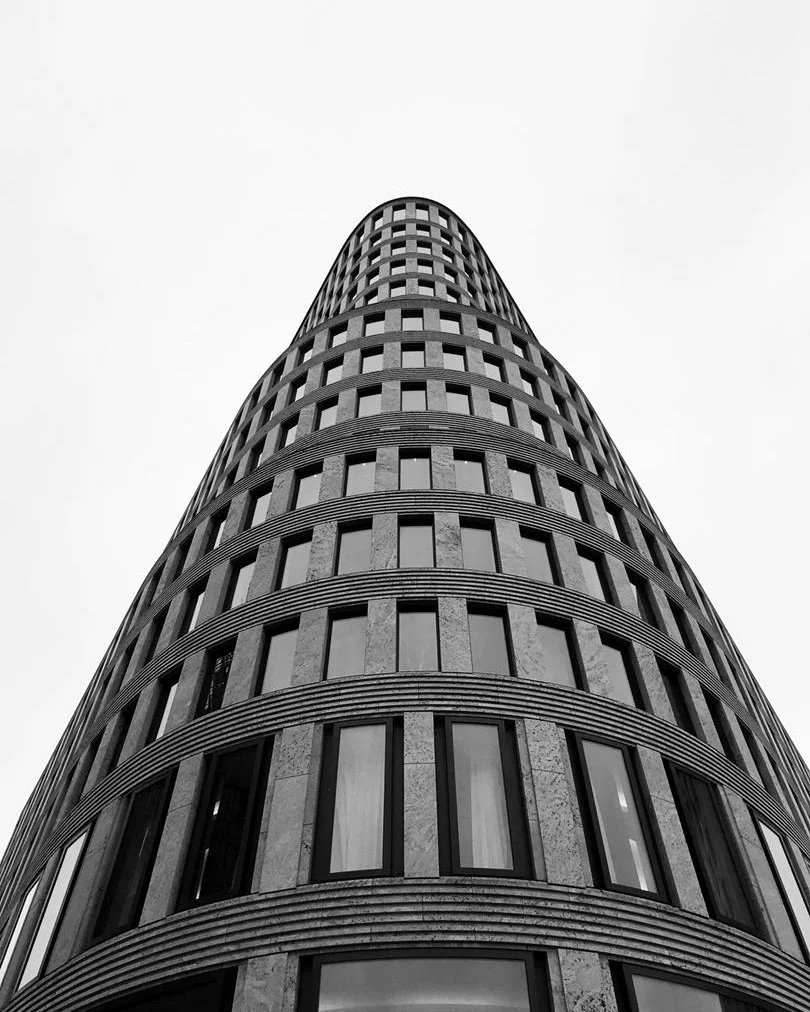


It remains one of my most iconic photographs of Berlin. The image also captures something I am drawn to in cities: the relationship between buildings. Architecture is rarely experienced as an isolated object. Buildings face one another, create public spaces, frame views and become part of the ways we move through a city.
The city was very different from Kampala, but I was interested in the things that connected rather than separated the two places. The collaboration itself provided one of those connections. Clothing became a way of thinking about how objects move between places. In Kampala, second-hand clothing is part of everyday life. Clothes arrive from elsewhere, are sorted and sold in markets, worn, altered and sometimes transformed into something else. In Berlin, I was able to think about the other end of some of these journeys.
The clothes were no longer simply objects. They carried stories about consumption, economies, fashion and the unequal relationships between places.
Walking Through the Collaboration
Part of the collaboration brought these ideas into public spaces in Berlin.
At Bikini Berlin, the work connected photography from Kampala with the broader STREETWARE project. It was interesting to see images and ideas that had developed in one place enter a completely different urban environment.
The collaboration made me think about photography differently.
Sometimes a photograph is a record of a place. At other times, it can become a bridge between places.
For me, this was one of those moments.
Walking Through History
Another memorable experience was walking through Berlin's African Quarter.
This was perhaps where walking became most important.
We were guided through the area by Mnyaka Sururu Mboro, and what initially appeared to be an ordinary walk through the city became an encounter with Germany's colonial history.
Street names became starting points for conversations about people, places and histories that were connected to Africa.
I realised again that cities can carry histories in very quiet ways.
You can walk down a street without knowing why it has been given a particular name. You can pass a building without knowing what happened there. You can live with the traces of history without necessarily seeing them.
Walking creates the possibility of stopping.
And sometimes, stopping is where the research begins.
I photographed some of what I encountered, but just as importantly, I listened.
Along the Spree
We also took a boat ride along the Spree, passing through Berlin and seeing the city from a different perspective.
From the water, the relationship between the city and its architecture felt different. Buildings, bridges and public spaces unfolded gradually along the river, offering another way of seeing Berlin.
After spending so much time walking through the city, being on the water gave me a moment to simply observe.
I found myself thinking again about rivers and movement. The year before, in Cairo, I had spent time following the Nile and thinking about its connection to Uganda. In Berlin, the Spree offered another encounter with a river running through a city, carrying its own histories and rhythms.
The boat ride became another way of experiencing the city—not from the street, but from the river.
Berlin on Foot
Looking back at Berlin, I don't remember it simply through individual photographs. I remember it through walks.
I remember the streets, the architecture, the conversations and the unexpected connections between Kampala and Berlin. I remember discovering that something as ordinary as a piece of clothing could open up questions about history, economics, identity and geography. And I remember how walking allowed all these things to sit alongside one another. My camera was with me, but I wasn't always looking for a photograph.
Sometimes I was simply trying to understand where I was. That remains an important part of how I work.
I walk into a city without always knowing what I will find. I allow the streets to guide me, and I let photography become a way of paying attention. Berlin reminded me that a city can be read in many ways, through its buildings, its streets, its people, its names, and the objects that pass through it. You just have to slow down enough to notice.
And sometimes, you have to walk.
